The Last 100km: Walking from Sarria to Santiago
The last 100km of the Camino Francés, from Sarria to Santiago de Compostela, is the busiest and most walked stretch of the entire Camino. It's also the version most people end up doing, because it's the minimum distance you need to cover on foot to earn your Compostela, and five or six days is realistic in a way that five or six weeks from France usually isn't for most people with a job and a limited amount of leave.
This is the stretch I get asked about more than any other. Below is what it's actually like: why so many people choose to start here, what the terrain and the crowds are really like, how you find your way and what's available along the road, and then a proper day by day breakdown of the five stages into Santiago.
Why so many people start in Sarria, and what the walking is like
Most pilgrims doing the full Camino Francés start in Saint-Jean-Pied-de-Port in France and walk close to 800km over five or six weeks. Sarria sits just past the 100km mark from Santiago, which makes it the obvious starting point for anyone who wants the Compostela without needing that much time off work. It's not a shortcut or a lesser version of the Camino. It's just the most practical one.
It does mean you're joining the busiest section of the whole route. You're walking alongside everyone who started weeks ago in France, plus everyone else who's just started with you in Sarria, so expect company on the trail and a bit of competition for beds in peak season.
As for the walking itself, Galicia is green, hilly, and often damp. Expect a mix of forest track, farm lanes, and short stretches alongside quiet roads, with plenty of gentle ups and downs but nothing technical and nothing that requires special fitness beyond a reasonable base level. The terrain isn't what catches people off guard on this stretch. The number of other walkers is.
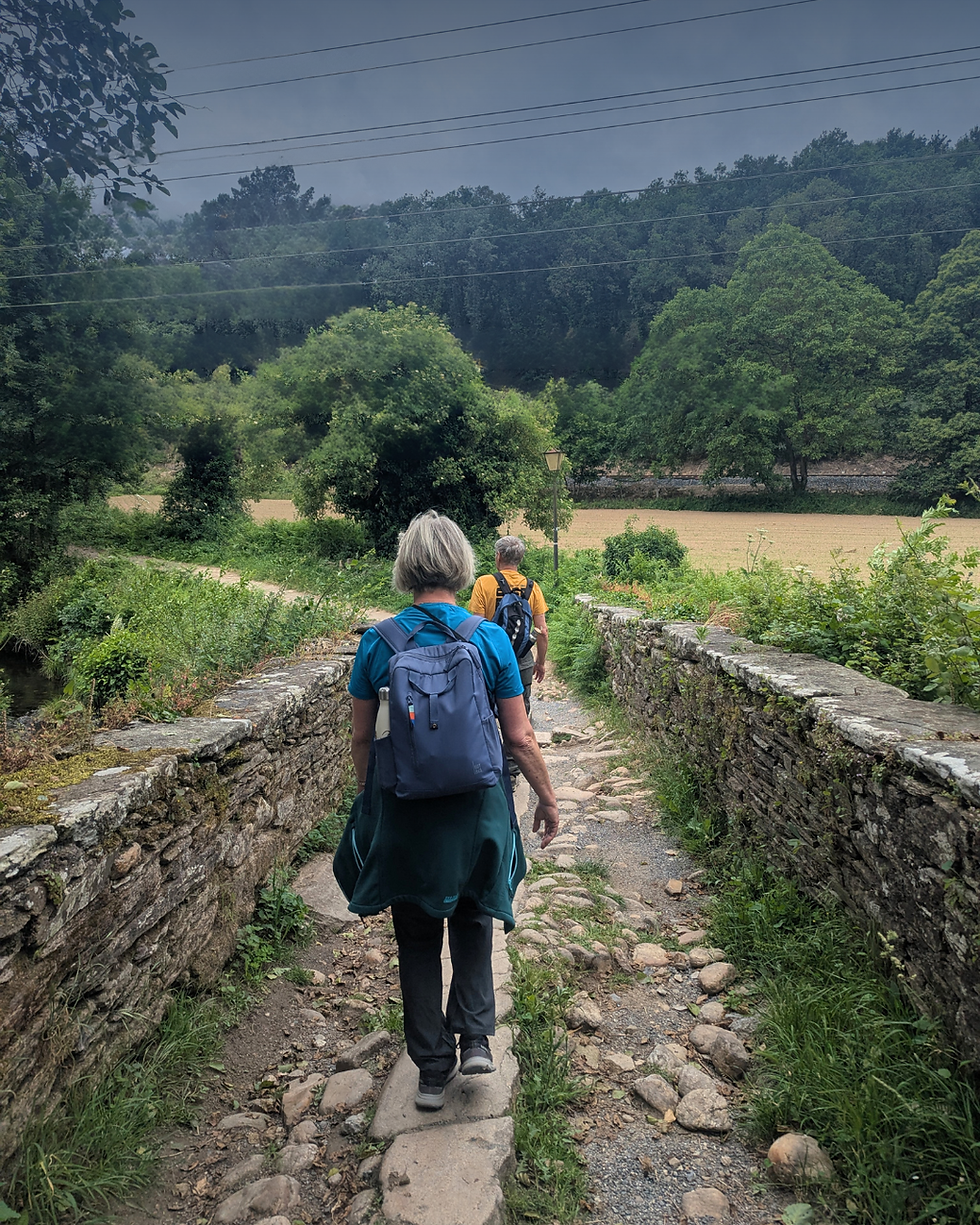
Camino way-marking: how you actually find your way
It's genuinely hard to get lost on this stretch. The whole Camino Francés is marked with two symbols: a yellow arrow pointing towards Santiago, and a scallop shell, usually painted on a blue tile. You'll see them on walls, tree trunks, kerbs, fence posts, and the odd café awning. Both always point one way, so if you're ever unsure at a junction, look for the arrow and follow it.
Galicia is the best signposted stretch of the entire Camino. Stone or concrete markers appear roughly every 500 metres, most carrying the yellow arrow, the shell, and the remaining distance to Santiago in kilometres. It's a handy way to track your progress through the day, and a bit of a ritual in itself, watching that number tick down. You don't need a GPS app for this stretch. If you go more than fifteen minutes without spotting a marker or another pilgrim, that's the moment to stop and check you haven't wandered off onto a farm track, but on this route that's a rare thing to happen.
Services and infrastructure along the way
This is one of the best supported stretches of the entire Camino, and part of why so many first timers choose it. Because so many pilgrims start in Sarria, every stage town, and most of the villages in between, has cafés, bars, and small shops set up specifically for passing walkers. You're rarely more than a few kilometres from somewhere to refill a water bottle, grab a coffee, or use a toilet.
Each of the five stage towns, Portomarín, Palas de Rei, Arzúa, O Pedrouzo, and Santiago itself, has pharmacies, ATMs, and at least a basic medical centre. Mobile coverage is solid the whole way through, which puts a lot of people's minds at ease before they set off. Accommodation ranges from simple pilgrim albergues with bunk beds and shared bathrooms through to private guesthouses and small hotels, so there's a genuine choice depending on how much comfort you want at the end of a walking day. The one thing worth remembering is that all this infrastructure exists because of the volume of walkers, so it's also the reason beds get booked out fast in peak season.
The Compostela and your credencial
To earn your Compostela, you'll need a credencial (pilgrim passport) stamped along the way. For the last 100km, the rule is two stamps per day rather than the usual one, since you're covering less ground than pilgrims who started further back. You can get your credencial from a pilgrim office, a church, or an albergue near your starting point, and stamps are easy to come by at cafés, churches, and accommodation all along the route.
At the Pilgrim's Office in Santiago, your credencial will be checked and you'll be issued your Compostela free of charge. There's also the option to pay a small additional fee for a distance certificate, which records exactly where you started and how far you walked. Expect a queue, particularly around midday, but it moves along steadily and it's a nice moment to swap stories with the people you've been leapfrogging all week.
The route, day by day
There's some flexibility in exactly how you break this up, but here's the standard five day itinerary.
Day 1: Sarria to Portomarín (22km)
You'll set off from Sarria's Rúa Maior, past the old prison building and up to a lookout point marked by a cross. From there the trail slips quickly out of town, past a 16th century convent and down toward a small tributary of the Sarria river, crossed by a medieval stone bridge. A short, sharp climb through chestnut trees brings you up past the remains of an old Roman hill fort and into the village of As Paredes.
This first stretch is dotted with tiny hamlets: Vilei, Barbadelo (home to a lovely Romanesque church worth a look if you have the legs for a small detour), Rente, and Mercado da Serra. Somewhere around here you'll pass a stone marking exactly 100km to Santiago, though there are actually two markers close together. Locals will tell you the real one is the second, older one, covered in stickers and graffiti from years of pilgrims.
The trail continues through Ferreiros, once home to blacksmiths who shod horses and studded pilgrims' boots for the road ahead, then rolls on through more small villages before a long, pretty descent to the Miño River. You'll cross into Portomarín via a striking 350 metre bridge. Portomarín itself has a fascinating backstory: the entire town was relocated in the 1960s when the valley was flooded to build a reservoir, and its most important buildings, including two beautiful Romanesque churches, were moved and rebuilt stone by stone on higher ground. If you're after a local specialty for dinner, this is the place to try eel pie, a Portomarín tradition you won't find as easily elsewhere on the route.
Day 2: Portomarín to Palas de Rei (25km)
Today starts with a solid climb out of Portomarín up Monte San Antonio, then settles into a rhythm of small villages, farmland, and the odd stretch alongside the road. You'll pass through Gonzar, where a detour leads to a well preserved pre-Roman hill fort at Castromaior if you're keen on a bit of ancient history.
The middle of the day takes you through Ventas de Narón and into the Sierra de Ligonde, a low mountain range that divides the Miño and Ulla river basins. Ligonde itself has a poignant pilgrim cemetery, a reminder that this road has been walked for over a thousand years. Not far past it, a signposted detour leads to the Monastery of Vilar de Donas, home to a small but beautifully carved Romanesque church that's worth the extra couple of kilometres if you have the time and energy.
As you near Palas de Rei you'll pass through O Rosario, named for pilgrims who used to stop and pray while gazing at Monte Sacro, a hill wrapped in local legend involving dragons, a Celtic queen, and the disciples of Saint James himself. Palas de Rei marks the end of the day, a good sized town with plenty of accommodation and, fittingly for the region, excellent Galician style octopus and the local Arzúa-Ulloa cheese to look forward to over dinner.

Day 3: Palas de Rei to Arzúa (29km)
This is the longest day on the standard itinerary, and a lot of walkers choose to split it in two with an overnight in Melide, roughly the halfway point. Melide is where the Camino Primitivo joins the Camino Francés, so you'll notice a jump in pilgrim numbers here, everyone converging on the same final stretch. It's also considered by many to have the best octopus on the entire Camino, so it's worth timing your lunch stop accordingly.
Past Melide, the trail winds through thick oak, pine, and eucalyptus forest, with a steady rhythm of small climbs and descents. You'll pass through Boente, where the parish church and a natural spring called the Fonte A Saleta are worth a quick look, then continue through Castañeda and down toward Ribadiso da Baixo. Here you'll cross a lovely medieval bridge to reach the old pilgrims' hospital of San Antón, now a public albergue right on the river, a genuinely picturesque spot for a rest stop even if you're not staying the night.
Arzúa itself is a town wrapped in local legend and said to have several spots with healing properties, worth asking a local about over a coffee. It's also known for its honey and its cheese, and it's where you'll likely cross paths with pilgrims arriving via the Camino del Norte as well, adding yet another stream of walkers to the crowd heading into the final days.
Day 4: Arzúa to O Pedrouzo (19km)
A noticeably gentler day, and most walkers use it to recover a little ahead of the final push. The trail eases out of Arzúa through small hamlets like As Barrosas and Taberna Vella before eucalyptus forest starts to dominate the landscape properly, its scent following you for most of the day.
You'll cross the N-547 highway a handful of times on underpasses and tunnels, which is really the only mild annoyance of the day. Not far before O Pedrouzo you'll pass the Chapel of Santa Irene, with a Baroque style fountain beside it that local legend credits with healing powers, said to have once cured a plague affecting the region's orchards. O Pedrouzo, technically in the parish of Arca, is a popular overnight stop because it leaves the ideal distance to reach Santiago in time for the midday Pilgrim's Mass the next day. It's also a good spot to slow down and take stock before the last stage.
Day 5: O Pedrouzo to Santiago (20km)
The big one. You'll start the day walking through more eucalyptus forest before the path skirts around Santiago airport, then continues through the villages of San Paio and Lavacolla. The little river here has real historical meaning: medieval pilgrims traditionally stopped to wash themselves and their clothes before entering the holy city, a ritual that gives the village its name.
From Lavacolla you'll climb steadily up to Monte do Gozo, the "Hill of Joy," home to a large monument built for the Jacobean Holy Year of 1993. This is the spot where pilgrims traditionally get their first glimpse of Santiago's cathedral spires in the distance, and it's an emotional moment even after only five days of walking. From there it's a gradual descent into the city, through increasingly urban streets, until you pass through the old Porta do Camiño gate and into the historic centre. A final walk past the Monastery of San Martín Pinario brings you out through a stone archway into the Plaza del Obradoiro, where the cathedral finally stands in front of you in full.
Give yourself time here. Hugs, tears, and the odd bit of stunned silence are all completely normal reactions in that square. Once you've had your moment, head to the Pilgrim's Office to have your credencial checked and collect your Compostela.
A few practical things worth knowing
Book your accommodation ahead if you're walking in peak season. Albergues along this stretch fill up quickly given how many people start in Sarria, and turning up hoping for a bed isn't the gamble it might have been on quieter parts of the Camino.
A daily luggage transfer service is worth considering too. It means you're walking with just a day pack rather than everything you own, which makes a real difference over five days of steady walking, particularly if you're newer to this kind of trip.
Pack layers. Galician weather can turn from warm sun to a passing shower within the same afternoon, and a light rain jacket earns its place in your bag more often than you'd think.
Is it worth doing if you can't walk the whole Camino?
Absolutely. I get asked this a lot, usually by people who feel like walking "only" the last 100km is somehow cheating or not the real thing. It isn't. You'll still walk into Santiago on your own two feet, still feel that moment when the cathedral spires come into view from Monte do Gozo, and still stand in the plaza with a Compostela in hand. The distance you walked to get there doesn't change how that feels.
If it fits your time and your fitness better than a full six week trip from France, that's not a lesser Camino. It's just your Camino.
I've built our Camino Francés Essentials trip around exactly this stretch, Sarria through to Santiago, with the route, accommodation, and daily support already sorted. If you'd like to talk through dates or how it all works, I'm easy to reach and happy to help you plan it properly.
Tierra Trekking Co. is an Australian and New Zealand tour company running self-guided Camino experiences. Our routes include the Camino Francés, the Portuguese Coastal Camino, and the Camino del Norte. Get in touch to find the right route and timing for your Camino.
Hi, I’m Ben
I’m Ben, founder of Tierra Trekking Co.
I’ve personally walked Camino routes across Spain, Portugal, France, and Italy, and started Tierra Trekking Co. to help Australians and New Zealanders experience these trails with practical support, thoughtful planning, and honest advice from someone who genuinely knows them.
If you’re unsure which Camino route is right for you, feel free to get in touch.


Comments