What Is a Pilgrim Passport on the Camino de Santiago?
Ask anyone who has walked the Camino what they brought home, and most will skip past the photos and go straight to a battered little booklet covered in colourful stamps.
That booklet is the credencial, better known as the pilgrim passport, and it ends up being one of the most treasured souvenirs of the whole walk. It costs a few euros, weighs almost nothing, and tells the story of your Camino one stamp at a time.
If you're planning your first Camino, here's everything you need to know about what the credencial is, where to get one, and how to use it along the way.
So what exactly is it?
The credencial is a small concertina-style booklet that identifies you as a pilgrim walking the Camino de Santiago. The idea goes back to the Middle Ages, when pilgrims carried letters of safe conduct from their local church or lord. These documents proved they were on a religious journey and entitled them to shelter and protection along the route.
The modern version does much the same job. It proves you're walking the Camino rather than just touring Spain, and it serves two practical purposes. First, it gives you access to pilgrim albergues, the hostels reserved for people walking or cycling the route. Second, it's your evidence for claiming the Compostela, the official certificate of completion issued by the Pilgrim's Office in Santiago.
Even if you're walking a self-guided tour with pre-booked private accommodation, as most of our walkers do, you'll still want a credencial. Without it, there's no Compostela at the end. And honestly, collecting the stamps is half the fun.
How the stamps work
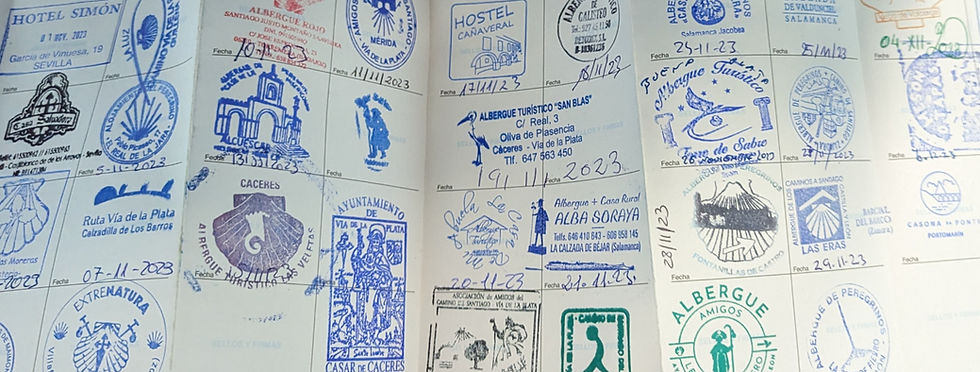
Each day on the Camino, you collect stamps, called sellos in Spanish, in your credencial. Albergues, hotels, churches, cathedrals, cafes, bars, town halls and even some shops have their own stamp, usually sitting on the counter next to an ink pad. You simply ask for a sello (pronounced SEH-yo) and they'll stamp and date your booklet.
Every stamp is different. Some are simple rubber stamps with a name and a scallop shell. Others are small works of art. Part of the daily rhythm of the Camino is deciding where to collect your stamp: the tiny stone chapel you passed at 9am, or the bar where you had the best tortilla of your life.
The rules are straightforward. For most of your walk, one stamp per day is enough. But in the final 100 kilometres before Santiago, you need a minimum of two stamps per day.
This is the Pilgrim's Office making sure that people claiming the Compostela have actually walked that final stretch rather than caught a bus. Get one stamp where you start each morning and one where you finish, and you're covered. Most walkers collect far more than that anyway.
Why the last 100 kilometres matter
To qualify for the Compostela, you need to walk at least the final 100 kilometres into Santiago de Compostela on foot, or cycle the final 200 kilometres. Your credencial, with its dated stamps, is how you prove it.
This is why towns like Sarria on the Camino Frances are so busy. Sarria sits just over 100 kilometres from Santiago, so it's the most popular starting point for walkers doing the minimum distance. On the Portuguese routes, Tui and Valenca on the Central route and Vigo on the Coastal route serve the same purpose.
When you arrive in Santiago, you take your stamped credencial to the Pilgrim's Office near the cathedral. A volunteer checks your stamps, asks a few questions about your journey, and issues your Compostela, a certificate written in Latin with your name on it. You can also request a separate distance certificate that records where you started and how far you walked. Plenty of our walkers frame both.
Where to get a credencial
The simplest approach is to pick one up when you arrive. All the popular starting towns have places that sell credencials for a few euros, usually the pilgrim office, the cathedral or one of the local albergues. In Saint-Jean-Pied-de-Port, the pilgrim office on Rue de la Citadelle issues them. In Porto, you can get one at the cathedral before setting off on the Portuguese routes. Just be aware that offices have opening hours, so if you're starting your walk early in the morning, it pays to get the credencial the afternoon before.
If you'd prefer to have it sorted before you leave Australia, the Australian Friends of the Camino (afotc.org) issue official credencials by post for a small fee. They're a volunteer organisation run by past pilgrims. Allow a few weeks for delivery, especially close to peak walking season.
A few practical tips
Keep it dry. A soggy credencial with running ink is a sad sight. A simple ziplock bag in your day pack does the job, and it keeps the booklet flat as well.
Don't run out of pages. If you're walking a longer route like the Camino Frances from Saint-Jean or the Via de la Plata, you may fill your credencial before Santiago. That's fine. Just buy a second one along the way and present both at the Pilgrim's Office. If you're an enthusiastic stamp collector, this can happen sooner than you'd think.
Write your details in pen. There's a section at the front for your name and the start date and place of your walk. Fill it in when you get it.
Stamp it even if you don't want the Compostela. Some walkers aren't fussed about the certificate. Collect the stamps anyway. The credencial becomes a day-by-day record of your journey, and years later, each stamp will bring back a specific morning, a specific village, a specific cup of coffee.
One small booklet, one big story
The credencial is one of those rare travel documents that's more keepsake than paperwork. It connects you to a thousand years of pilgrims who carried something very similar, and by the time you reach Santiago, it will be uniquely yours. No two credencials end up the same.
All of our self-guided Camino tours include guidance on getting your credencial sorted before you leave home, along with everything else you need to walk with confidence. If you're thinking about your first Camino, take a look at our routes or get in touch. We've walked every one of them ourselves, stamps and all.
Tierra Trekking Co. is an Australian and New Zealand tour company running self-guided Camino experiences. Our routes include the Camino Francés, the Portuguese Coastal Camino, and the Camino del Norte. Get in touch to find the right route and timing for your Camino.
Hi, I’m Ben
I’m Ben, founder of Tierra Trekking Co.
I’ve personally walked Camino routes across Spain, Portugal, France, and Italy, and started Tierra Trekking Co. to help Australians and New Zealanders experience these trails with practical support, thoughtful planning, and honest advice from someone who genuinely knows them.
If you’re unsure which Camino route is right for you, feel free to get in touch.


Comments